


- Junior Kindergarten
- Senior Kindergarten
Junior KG
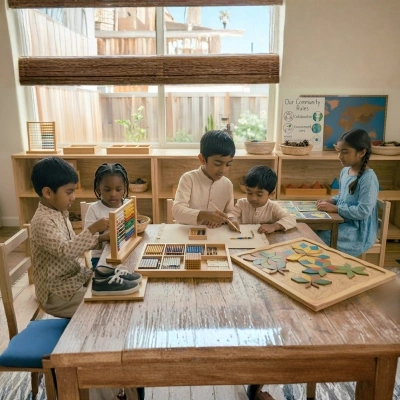
Our Junior KG program lays the groundwork for academic readiness. Through interactive and immersive learning experiences, children develop essential pre-literacy and numeracy skills, along with critical thinking, creativity, and self-expression.
About program
At 4.5 years, a child’s brain undergoes a significant shift. The neural pathways are now ready to handle abstract concepts. The brain is now capable of "symbolic representation," meaning it can understand that a letter represents a sound and a number represents a quantity.
The brain is highly sensitive to the sounds of language, making this the "golden window" for reading readiness.
The child begins to seek order, sequence, and patterns in everything they see, moving toward logical reasoning and problem-solving.
At this age, children are building "community logic." They understand rules, fairness, and the importance of contributing to the group.
In our Junior KG program, we don't use rote memorization. Instead, we use the natural world as our primary textbook to build a strong academic foundation.


Meaningful Literacy
We make language feel real. By connecting sounds and symbols through hands-on discovery, reading and writing become natural tools for expression rather than just classroom exercises.

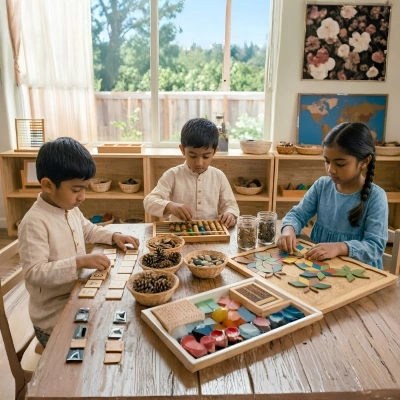
Real-World Logic
Mathematics is about more than numbers on a page. We help children find patterns and logic in their surroundings, building a sharp, analytical mind ready for complex problem-solving.

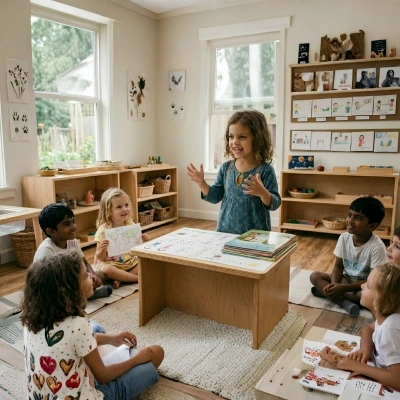
Leadership & Responsibility
Children step into active roles here. By managing meaningful tasks, they strengthen their focus and self-discipline, developing the confidence needed for future academic leadership.

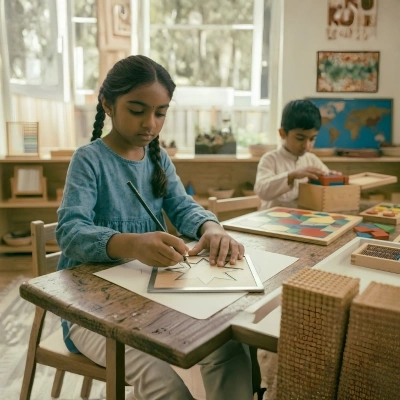
Focus & Precision
We challenge our learners with intricate work that refines the connection between the mind and the hand. This builds the steady concentration and fine motor control required for elegant penmanship.
Senior KG
The Senior KG program is designed to prepare children for a confident transition into formal schooling. With a refined balance of academics and experiential learning, we nurture independence, problem-solving abilities, and a lifelong love for learning.
About program
At 5.5 years, the brain is undergoing a major shift—it is moving from the "absorbent" phase into the "reasoning" phase. This is the age where the left and right hemispheres start communicating more efficiently, allowing for complex logic and self-reflection.
At this stage, the brain undergoes a "cognitive growth spurt." The prefrontal cortex—the part of the brain responsible for planning and decision-making—becomes much more active. Your child is no longer just collecting facts; they are starting to connect them to understand the "big picture."
The bridge between the left brain (logic/language) and the right brain (creativity/intuition) strengthens. This allows children to solve problems creatively while following logical steps.
This is the birth of "thinking about thinking." Children begin to plan how they will solve a task before they start, a key sign of academic maturity.
Their "working memory" expands, allowing them to hold multiple pieces of information at once—essential for reading comprehension and mental math.
In our final early-years stage, the child transitions from a student of the world to a master of their own learning. We focus on "Applied Wisdom," ensuring that every child is not just academically ready for the next grade, but intellectually curious and socially poised.

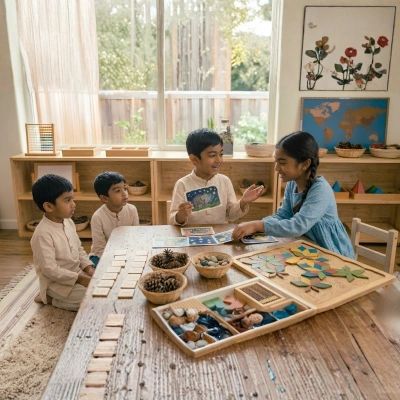
Fluent Expression
We move into advanced literacy by focusing on the flow of thoughts. Beyond just reading, we encourage children to become storytellers and communicators, using their language skills to share complex ideas and creative narratives.

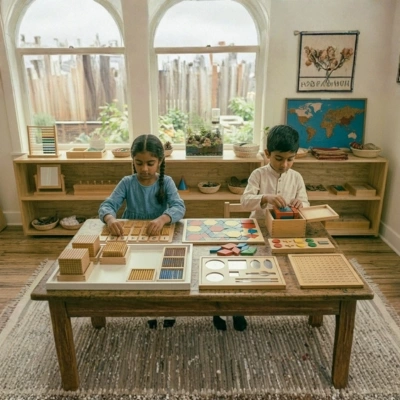
Mathematical Intuition
At this level, logic becomes second nature. We explore the deeper relationships between numbers, shapes, and measurements. By mastering these concepts through physical experience, children develop a "math-mind" that can solve problems with speed and clarity.

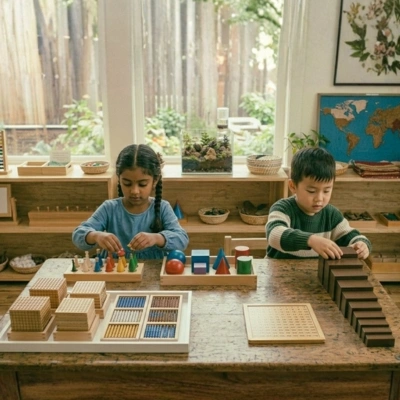
Critical Thinking & Inquiry
We encourage our learners to ask "What if?" and "How might we?" By engaging in project-based discovery, they learn to gather information, analyze patterns, and draw their own conclusions—the hallmark of a sophisticated learner.
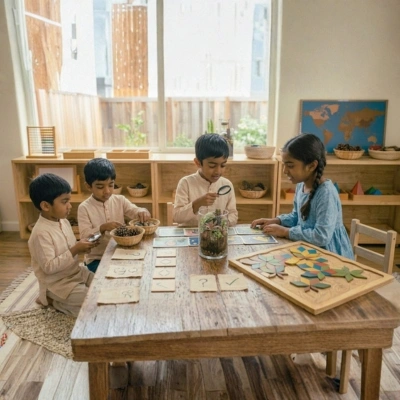
Inquiry-Based Discovery
We feed the "Reasoning Mind" by encouraging inquiry. Instead of giving answers, we ask questions that challenge the brain to analyze, compare, and draw conclusions. This builds a sharp, critical-thinking mind that is ready for any academic challenge.
Self-Sovereignty & Leadership
The UKG child is a leader in our community. We provide opportunities for them to mentor younger peers and take ownership of their environment. This builds a deep sense of social responsibility and the executive function required for the transitions ahead.